
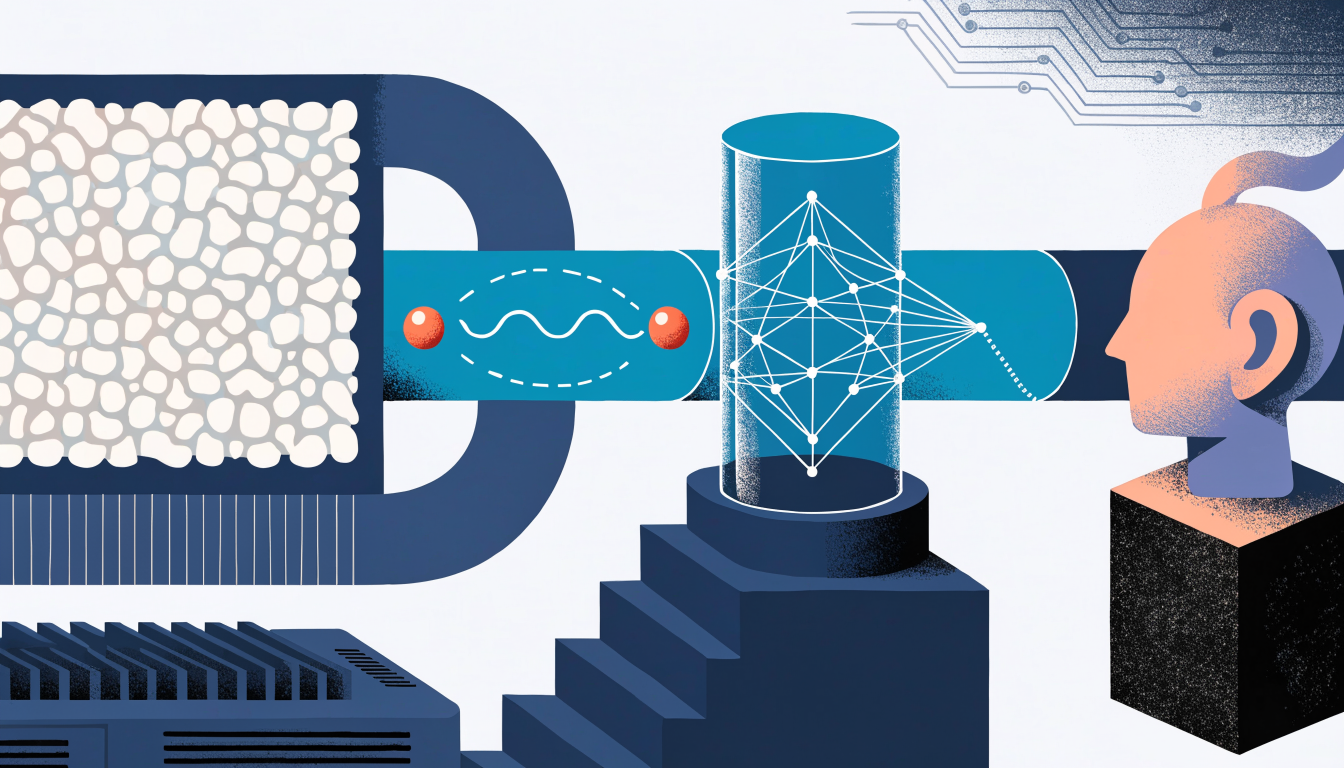
Building a large language model from scratch is one of the most ambitious projects a developer can take on, but the core ideas are more approachable than the hype suggests. If you want to understand how to make an LLM, you are really asking about three distinct phases: assembling and preparing a large text corpus, training a transformer-based neural network on that corpus, and then aligning the resulting model so it behaves usefully. Each phase has different cost profiles, tooling requirements, and failure modes, and knowing where your goals fall on the spectrum from "tiny character-level model on a laptop" to "instruction-tuned assistant" will shape every decision you make. This guide walks through the full pipeline with realistic code, honest tradeoffs, and the mistakes that most commonly derail first attempts.
Understanding What an LLM Actually Is
Before writing any code, it helps to demystify the term. A large language model is a neural network, almost always a transformer architecture, trained to predict the next token in a sequence. That single training objective, applied at massive scale, produces models that can answer questions, write code, and translate languages. There is no explicit database of facts inside the model — knowledge is encoded in billions of learned weights.
The word "large" is relative. Frontier models like GPT-4 and Claude are widely believed to operate at a far larger scale than anything an individual can train — their exact parameter counts and training token counts have never been published, but public estimates put them at hundreds of billions of parameters and trillions of tokens, trained on clusters of thousands of GPUs. Treat those numbers as informed guesses, not verified specifications. The important point is that the same architecture works at much smaller scales. Tiny research models with 10–100 million parameters can be trained on a single GPU and still produce coherent, if limited, text; models like GPT-2 (up to 1.5 billion parameters) sit in between, but training the largest GPT-2 variant from scratch is already a multi-GPU undertaking. Andrej Karpathy's nanoGPT project demonstrates the small end of this spectrum well: a complete, readable GPT implementation in a few hundred lines of PyTorch.
The practical implication is that "making an LLM" is a spectrum. You can train a small model to understand the process deeply, or you can fine-tune an existing open-weight model to get useful results quickly. Most developers should start with the former for learning and the latter for production.
The Core Pipeline: Data, Tokenization, and Training
Every LLM project starts with data. Language models learn from raw text, and the quality and diversity of that text largely determines model quality. Common sources include Wikipedia, open code repositories, books, and curated web crawls such as The Pile or Common Crawl derivatives. For a first project, a single-domain corpus — say, all of Shakespeare or a programming language's documentation — is far more tractable and produces visibly better results than a tiny slice of general web text.
Next comes tokenization, the process of converting text into integers the model can consume. Most modern LLMs use byte-pair encoding (BPE) or variants like SentencePiece, which learn a vocabulary of subword units from your corpus. Subword tokenization handles rare words and typos gracefully, unlike naive word-level approaches. (Character-level tokenization also handles rare words well, but produces much longer sequences, which raises compute costs.) The Hugging Face tokenizers library makes training a BPE tokenizer straightforward:
from tokenizers import Tokenizer, models, trainers, pre_tokenizers

tokenizer = Tokenizer(models.BPE(unk_token="[UNK]"))
tokenizer.pre_tokenizer = pre_tokenizers.Whitespace()

trainer = trainers.BpeTrainer(
    vocab_size=8000,
    special_tokens=["[UNK]", "[EOS]"]
)
tokenizer.train(["corpus.txt"], trainer)
tokenizer.save("tokenizer.json")
This example uses the Python API from tokenizers==0.22.1; install that version in an isolated environment to reproduce it. The pinned trainer interface accepts special-token strings, while the BPE model interface defines unk_token. Here [UNK] handles characters absent from the training corpus. [EOS] reserves an end-of-document vocabulary entry, but registering it does not automatically append it to encoded text; add boundary tokens explicitly when preparing model-training sequences.
With tokenized data in hand, you define the model. A minimal decoder-only transformer consists of token embeddings, positional information (learned positions or rotary embeddings), stacked blocks of multi-head self-attention and feed-forward layers, and a final linear projection that produces a probability distribution over the vocabulary. In PyTorch, the training loop is a standard next-token prediction objective:
import torch
import torch.nn.functional as F

def train_step(model, batch, optimizer):
    inputs, targets = batch[:, :-1], batch[:, 1:]
    logits = model(inputs)
    loss = F.cross_entropy(
        logits.reshape(-1, logits.size(-1)),
        targets.reshape(-1),
    )
    optimizer.zero_grad()
    loss.backward()
    optimizer.step()
    return loss.item()
The key hyperparameters are model size (layers, embedding dimension, attention heads), context length, learning rate, and batch size. A common mistake is setting the learning rate too high, which causes the loss to spike or diverge, or too low, which wastes GPU hours. Use a learning rate warmup followed by cosine decay — this is the standard schedule in essentially every published LLM training run, and skipping it is one of the most frequent causes of unstable training in DIY projects.
Compute Realities and When to Fine-Tune Instead
Training from scratch is expensive in a way that surprises people. Even a modest 100-million-parameter model trained on a few billion tokens requires multiple GPU-days. Scaling laws mean model quality improves predictably with more data and parameters, but the costs grow superlinearly. A realistic rule of thumb: if you cannot dedicate at least one modern GPU for several days, training from scratch will not yield a generally useful model.
This is why fine-tuning is useful for practical adaptation. Open-weight models such as Llama and Mistral can use LoRA (Low-Rank Adaptation), which trains small adapter matrices while keeping the base weights frozen. The trainable-parameter reduction depends on adapter rank and target layers. QLoRA combines adapters with a quantized base model; the official PEFT quantization guide describes a 4-bit workflow. Whether a 7B LoRA job fits in 24 GB depends on weight precision, sequence length, microbatch size, adapter configuration, and activation-memory optimizations. Quantization reduces weight storage but does not eliminate other memory costs. Measure peak usage with your actual configuration instead of treating 24 GB as a universal boundary.
The decision framework is straightforward:
- Learning goal: train a small model from scratch (nanoGPT-scale) to understand the mechanics.
- Domain adaptation: fine-tune an existing open-weight model with LoRA (or QLoRA) on your own data.
- General capability: do not attempt this from scratch; use an API or an existing open model.
A common mistake is fine-tuning when retrieval-augmented generation (RAG) would suffice. If your goal is letting a model answer questions about specific documents, RAG — retrieving relevant text at inference time and placing it in the prompt — is cheaper, easier to update, and less prone to hallucination than baking knowledge into weights. Fine-tune for style, format, and behavior; use RAG for knowledge.
Aligning the Model: From Raw Predictor to Useful Assistant
A model trained purely on next-token prediction completes text; it does not follow instructions. If you prompt it with "Write a haiku about databases," it may instead continue with something like "Write a haiku about databases and other poetic prompts for…" because that pattern appeared in training data. Turning a raw predictor into an assistant requires alignment, typically done in stages.
The first stage is supervised fine-tuning (SFT): train on examples of instruction-response pairs so the model learns the format of being an assistant. Datasets like OpenAssistant or Alpaca-style instruction data are commonly used. The second stage, used by most frontier labs, involves preference learning — techniques like RLHF (reinforcement learning from human feedback) or DPO (Direct Preference Optimization) — where the model is trained to prefer responses humans rated higher over ones they rated lower. DPO is considerably simpler to implement than full RLHF and has become the standard choice for open-weight projects.
For a DIY project, SFT alone gets you most of the way. Fine-tuning a small base model on a few thousand high-quality instruction pairs will produce a model that follows simple instructions, even if its reasoning remains shallow. The main pitfall here is data quality: a small amount of carefully written, diverse instruction data consistently outperforms a large amount of noisy, repetitive examples.
Evaluation and Common Failure Modes
Evaluating an LLM is harder than evaluating typical software because there is no single correct output. Standard benchmarks such as MMLU or HellaSwag measure broad capability, but for a domain-specific model, build a small evaluation set of prompts with known good answers and check outputs manually or with an LLM-as-judge approach. Track perplexity during training as a sanity signal — it should decrease steadily and plateau; if it plateaus early at a high value, your model is likely underpowered or your data is too narrow.
Watch for these recurring problems:
- Repetition loops: small models often get stuck repeating phrases. More training data diversity and slightly higher sampling temperature at inference help.
- Catastrophic forgetting: fine-tuning too aggressively on narrow data erases general capability. Lower the learning rate and mix in some general data.
- Overfitting to format: if all your training examples share one template, the model may only work with that exact template.
- Context length confusion: a model trained with a 512-token context cannot reliably handle longer inputs at inference without context-extension techniques such as positional interpolation, and even then, quality at lengths well beyond training context is not guaranteed.
Finally, be honest about safety. A from-scratch model has no content filtering, no refusal behavior, and no guardrails. If you deploy anything publicly, add input and output filtering at the application layer, because the model itself will not provide any.
Frequently Asked Questions
It depends entirely on scale. A tiny 10–50 million parameter model on a small corpus can be trained on a single consumer GPU in hours, effectively for the cost of electricity or a few dollars of cloud compute. A competitive open model in the 7-billion-parameter class, by contrast, requires a compute budget orders of magnitude beyond anything an individual can fund — published open-model training runs at that scale report thousands of GPU-days, and exact figures vary by model and hardware — so it sits well beyond individual budgets. Most individuals should either train very small models for learning or fine-tune existing open-weight models.
You need a working understanding of attention, cross-entropy loss, and gradient descent, but you do not need to derive transformer equations from scratch. Frameworks like PyTorch and libraries like Hugging Face Transformers handle the heavy lifting. Reading the “Attention Is All You Need” paper and working through nanoGPT covers the essential conceptual ground.
Yes, but fine-tuning is usually the wrong tool. Use retrieval-augmented generation instead: store documents in a vector database, retrieve relevant passages at query time, and pass them to an existing model in the prompt. This is cheaper, updates instantly when documents change, and makes answers easier to verify. Fine-tuning is better suited to teaching a model a style or task format rather than facts.
A single GPU with at least 16 GB of VRAM is comfortable for training small models and quantized LoRA (QLoRA) fine-tuning. Cloud GPU instances from providers like Lambda or RunPod let you rent suitable hardware by the hour. You can also train character-level models on a CPU, though slowly — this is a viable way to learn the pipeline before spending on compute.
Rarely. Training from scratch makes sense when you have a highly specialized domain, unusual data (such as protein sequences or a low-resource language), strict data sovereignty requirements, and serious compute budget. For nearly all product use cases, fine-tuning an existing open-weight model or building on an API delivers better results at a fraction of the cost.
Conclusion
Making an LLM is a well-understood pipeline — tokenize text, train a transformer to predict the next token, then align it with instruction data — and every stage has accessible tooling today. Start small: train a character or BPE-level model on a modest corpus with nanoGPT to internalize the mechanics, then move to quantized LoRA fine-tuning of an open-weight model when you need practical results. Reserve RAG for knowledge-heavy applications, and evaluate honestly with a small hand-built test set rather than trusting training loss alone. The best next step is to clone nanoGPT and run a training job on a small dataset this week — reading about transformers teaches far less than watching your own model's loss curve descend for the first time.
Transparency Note: Links in this article are not affiliate links. I recommend these tools and platforms based on their relevance to the topic, and no compensation is received for including them.