
If you are building an AI agent, a RAG pipeline, or any application that needs to pull live data from the web, you have probably run into the same decision: should you use Firecrawl or Tavily? Both tools are popular in the LLM tooling ecosystem, both expose simple APIs, and both are frequently listed side by side in agent frameworks. But they are not interchangeable, and choosing the wrong one can cost you either data quality or development time.
The short version: Firecrawl is a web scraping and crawling platform that turns websites into clean, LLM-ready markdown, while Tavily is a search-oriented API designed to answer queries by retrieving and processing relevant web results. This article breaks down where each tool excels, where it falls short, and how to decide between them for your specific project.
What Each Tool Is Actually Designed to Do
Firecrawl (from Mendable) is fundamentally a scraping and crawling engine. You give it a URL, and it returns the page content as clean markdown, structured data, or a screenshot. Its standout capability is crawling: you can point it at a domain and let it recursively discover and scrape hundreds or thousands of pages, returning everything in a consistent format. It also offers a /scrape endpoint for single pages and supports actions like waiting for JavaScript rendering, which matters for single-page applications.
Tavily is built around search. You send it a natural-language query, and it performs web searches, retrieves the most relevant results, extracts content from those pages, and returns a synthesized, LLM-friendly response. It was designed specifically as a search tool for AI agents, which is why it integrates so tightly with frameworks like LangChain and LlamaIndex. Its research-oriented endpoints can even produce a synthesized answer with sources rather than raw page content.
The core distinction is this: Firecrawl answers "give me the content of this URL or this site," while Tavily answers "find me information about this topic." If you already know the URL, Firecrawl is the natural fit. If you only have a question, Tavily is usually the better starting point.
Key Differences That Matter in Practice
Data retrieval model
Firecrawl gives you deterministic, page-level control. You specify the URL, the output format (markdown, HTML, structured extraction), and optional crawling rules such as include/exclude path patterns and crawl depth. This makes it predictable and repeatable, which is important when you are building a documentation ingestion pipeline or monitoring specific pages.
Tavily is query-driven and probabilistic. You describe what you want, and its search layer decides which results to fetch. That is powerful for open-ended research tasks, but it means you have less control over exactly which sources are used. If your application requires auditing every source or guaranteeing coverage of a specific domain, you will spend more effort validating Tavily's results.
Structured extraction
Both tools have moved toward structured output. Firecrawl supports extraction with a JSON schema, letting you define the fields you want pulled from a page. Tavily also supports structured output in its search responses, and its extract endpoint can pull content from specific URLs, which blurs the line between the two tools somewhat. In practice, Firecrawl's schema-driven extraction tends to be the stronger choice when you are working with known page layouts, while Tavily's structured search output is better when the schema describes the answer rather than the page.
Freshness and rate considerations
Tavily's search index is optimized for retrieving current web results, which makes it a good fit for questions about recent events or fast-moving topics. Firecrawl fetches pages live at request time, so freshness depends on the target site itself. The tradeoff is that live fetching is slower and can hit anti-bot protections on aggressive sites, whereas a search-backed API abstracts that away.
Pricing and scale
Both offer free tiers with limited credits and paid plans that scale with usage. Firecrawl's pricing is typically tied to pages scraped or crawled, while Tavily's is tied to search and extraction credits. If you are crawling an entire documentation site once, Firecrawl's credit model usually works in your favor. If you are running many small searches per user query in a chatbot, Tavily's model is often more economical. Check both pricing pages before committing, because credit structures change over time.
A Practical Example: Building a Research Agent
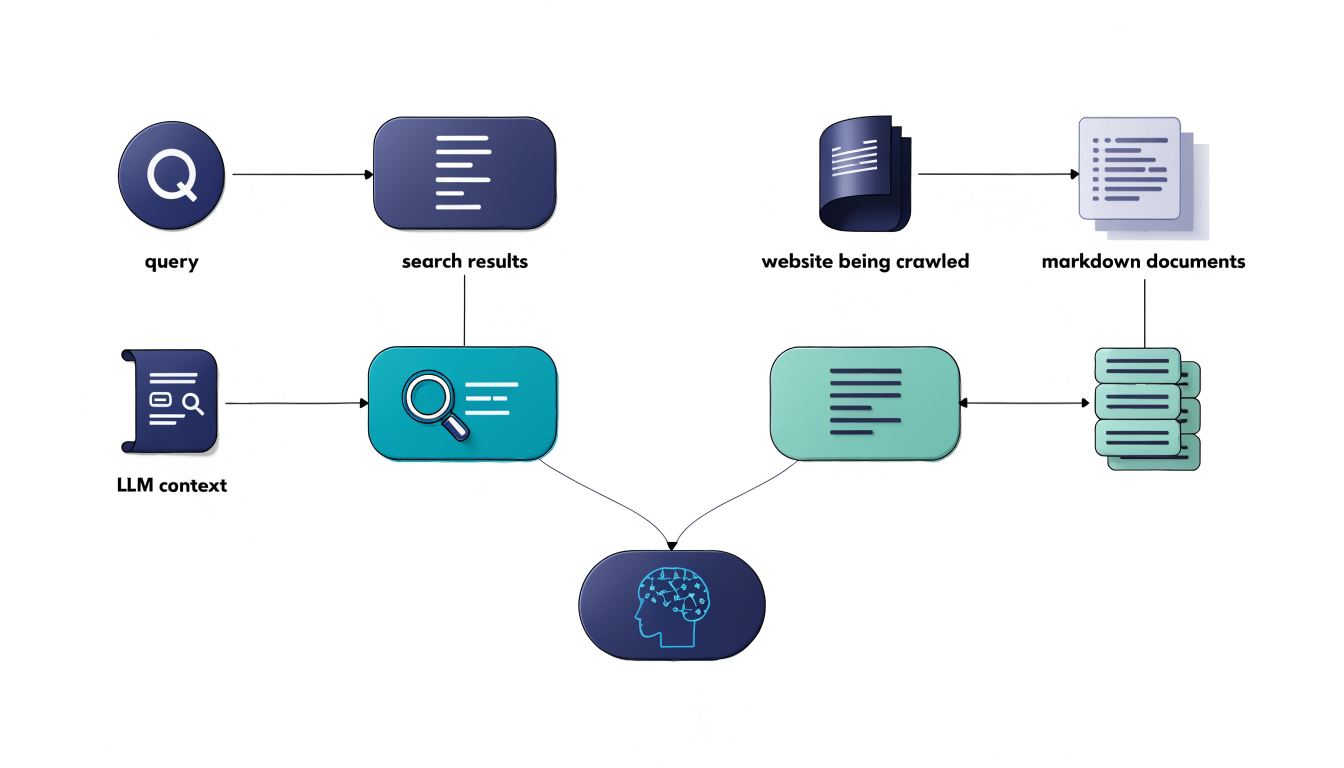
Suppose you are building an agent that answers developer questions about a specific library. A realistic hybrid workflow looks like this:
- Use Tavily to search the web for pages discussing the user's question.
- Filter or rank the returned URLs.
- Pass the most promising URLs to Firecrawl for full-page extraction and deeper crawling of documentation sites.
- Feed the resulting markdown into your LLM context.
This pattern is common because the tools complement each other rather than compete. Tavily handles discovery; Firecrawl handles depth. Many agent frameworks, including LangChain and LlamaIndex, offer integrations for both, so wiring them together is straightforward.
Here is a minimal Python sketch showing both tools in one pipeline:
from firecrawl import FirecrawlApp
from tavily import TavilyClient

firecrawl = FirecrawlApp(api_key="fc-...")
tavily = TavilyClient(api_key="tvly-...")

# Step 1: discover relevant pages with Tavily
results = tavily.search(
    query="How do I use streaming responses with the OpenAI API?",
    max_results=5,
)

# Step 2: extract full content from the best result with Firecrawl
best_url = results["results"][0]["url"]
page = firecrawl.scrape_url(best_url, params={"formats": ["markdown"]})

# Step 3: hand the markdown to your LLM pipeline
context = page["markdown"]
print(context[:500])
Note that the exact SDK method names can change between versions, so always verify against the current Firecrawl documentation and Tavily documentation before shipping code like this.
Where Each Tool Falls Short
No tool is a universal answer, and both have limitations worth knowing before you commit.
Firecrawl's main weaknesses show up when you do not know which URLs to fetch. It has search capabilities, but its strength is not ranking results across the open web. Live scraping also means you inherit the web's problems: JavaScript-heavy sites, paywalls, bot detection, and pages that change structure without warning. If your pipeline depends on scraping a site that actively blocks scrapers, expect occasional failures regardless of which scraping tool you use.
Tavily's main weakness is control. Because it is search-driven, you cannot guarantee it will consult a specific source, and its content extraction is shallower than a dedicated crawler's. It is also not designed for bulk crawling, so if you need to ingest 5,000 documentation pages, using Tavily for that would be awkward and expensive. Finally, its synthesized answers are convenient but can obscure the underlying sources, which matters if your application needs citations with full context.
A common mistake is picking one tool and forcing it to do the other's job, for example using a search API to crawl a documentation site page by page. That approach burns credits and produces worse results than the purpose-built tool would.
Which One Should You Choose?
Use these rules of thumb:
- Choose Firecrawl if you know the target URLs, need to crawl entire sites, want deterministic markdown output for RAG ingestion, or need schema-based extraction from known page layouts.
- Choose Tavily if you are building an agent that needs to answer open-ended questions with current web information, want a search layer designed for LLMs, or need fast integration with agent frameworks.
- Use both if your application needs discovery plus depth, which is the most common pattern in production research agents.
If you are prototyping and can only pick one, start with Tavily for conversational agents and Firecrawl for data pipelines. Your use case, not the tool's feature list, should drive the decision.
Frequently Asked Questions
Yes, and this is a common pattern. Tavily handles web search and discovery, returning relevant URLs for a query, while Firecrawl performs deep scraping and crawling of those URLs for full-page content. Combining them gives you both breadth and depth in an AI research pipeline.
It depends on your data source. If you are ingesting a known set of websites or documentation, Firecrawl’s crawling and markdown output are ideal for building your corpus. If your RAG application needs to retrieve fresh information from the open web at query time, Tavily’s search-first design is the better fit.
Yes, both Firecrawl and Tavily offer free tiers with a limited number of credits, which is enough for prototyping and small projects. Credit structures and limits change over time, so review the current pricing pages on each product’s website before committing to a plan.
Firecrawl explicitly supports rendering JavaScript before extraction, which makes it the safer choice for single-page applications and dynamic sites. Tavily extracts content from pages it retrieves via search, and its handling of heavily dynamic pages is less controllable since you do not manage the fetch directly.
Pricing depends entirely on your usage pattern. Firecrawl charges based on pages scraped or crawled, which favors bulk ingestion jobs. Tavily charges per search and extraction, which favors applications making many small queries. Estimate your expected monthly volume against both pricing pages to see which is more economical for your workload.
Conclusion
The Firecrawl vs Tavily decision is less about which tool is better and more about which problem you are solving. Firecrawl is the stronger choice for deterministic scraping, site-wide crawling, and building RAG corpora from known URLs. Tavily is the stronger choice for open-ended, search-driven retrieval inside AI agents. In many real projects, the right answer is to use both: Tavily for discovery, Firecrawl for depth. A good next step is to sign up for both free tiers and run your actual use case against each API, since a small prototype will tell you more about fit than any feature comparison.
Transparency Note: Links in this article are not affiliate links. I recommend these tools and platforms based on their relevance to the topic, and no compensation is received for including them.